3
Archaeology Ireland
Winter 2017
Introduction
At
this
time
of
year,
attention
focuses
on
the
orientation
of
Newgrange
towards
sunrise
at
the
midwinter
solstice.
For
many
people
this
prehistoric
phenomenon,
dating
back
over
5,000
years,
has
become
linked
with
the
celebration
of
Christmas
and
the
turning
of
the
year.
In
2016
there
was
media
coverage
of
the
suggestion
by
Michael
Gibbons
that
the
alignment
of
the
roof-box
at
Newgrange,
through
which
the
sun
shines
to
illuminate
the
passage
and
chamber
at
winter
solstice
sunrise,
was
the
result
of
the
reconstruction
of
this
feature
by
the
late
Professor
M.J.
O’Kelly,
who
excavated
and
restored
the
monument.
While
there
are
aspects
of
the
Newgrange
reconstruction
that
are
open
to
debate,
notably
the
quartz
wall
flanking
the
entrance,
there
is
widespread
agreement,
as
first
scientifically
described
by
Jon
Patrick
and
Tom
Ray,
and
argued
by
Geraldine
Stout,
that
the
original
and
authentic
purpose
of
the
roof-box
was
to
capture
the
beam
of
winter
solstice
sunlight
and
direct
it
to
the
back
of
the
chamber.
Equally
important
in
understanding
the
wider
significance
of
the
Newgrange
alignment
is
that
it
is
not
unique.
Deliberate
solar
orientation
is
a
recurring
element
of
the
passage
tomb
tradition,
in
Ireland
and
further
afield.
In
the
Boyne
Valley
the
sun
illuminates
the
southern
tomb
at
Dowth
at
winter
solstice
sunset
and
Townley
Hall
passage
tomb
at
summer
solstice
sunrise.
Cairn
T,
the
central
tomb
in
the
Loughcrew
passage
cemetery
complex,
is
orientated
towards
sunrise
around
the
time
of
the
spring
and
autumn
equinoxes.
Further
afield,
the
passage
tomb
of
Maes
Howe
in
Orkney
is
illuminated
at
sunset
at
the
winter
solstice,
and
the
passage
tomb
at
Bryn
Celli
Ddu
in
Wales
is
aligned
towards
summer
solstice
sunrise.
It
seems
timely
to
focus
on
this
important
element
of
the
cultural
practices
surrounding
the
construction
and
use
of
these
monuments
during
the
Neolithic
period
and
to
ask
the
specific
question
of
why
solstitial
and,
in
a
few
cases,
orientations
close
to
sunrise
and
sunset
near
the
equinoxes
were
incorporated
into
passage
tomb
architecture.
Positional
astronomy
and
solar
alignments
Solstices
and
equinoxes
are
four
events
that
predictably
reoccur
as
the
earth
makes
one
revolution
of
the
sun
in
365.2422
days,
a
period
known
as
the
tropical
year
(Fig.
1).
Winter
and
summer
solstices
can
happen
at
any
time
within
21–22
December
and
20–22
June
respectively,
while
the
vernal
and
autumnal
equinoxes
can
similarly
fall
within
19–21
March
and
22–23
September
respectively.
Relatedly,
the
next
winter
solstice
will
occur
on
21
December
at
16:28
UTC
(Coordinated
Universal
Time,
the
time-
scale
available
from
broadcast
time
signals).
The
solstices
and
equinoxes
also
conveniently
divide
the
year
into
quarters,
each
with
an
average
duration
of
c
.
91
days.
When
thinking
about
the
observed
sky
in
prehistoric
times,
we
first
need
to
consider
briefly
the
aspect
and
motion
of
earth’s
axis
in
space.
It
is
currently
tilted
at
23°.4
and
this
creates
the
four
seasons,
giving
associated
weather
patterns
and
diurnal
and
seasonal
differences
in
light
levels.
Crucially,
axis
tilt
also
causes
very
noticeable
changes
in
the
direction
of
sunrise
and
sunset
throughout
the
year.
These
reach
a
limit
in
the
south-east
and
south-west
in
late
December,
and
in
the
north-east
and
north-
west
in
late
June,
on
what
are
known
as
‘solstice
days’.
On
those,
and
for
a
period
lasting
for
about
five
days
on
either
side,
the
naked
eye
cannot
perceive
significant
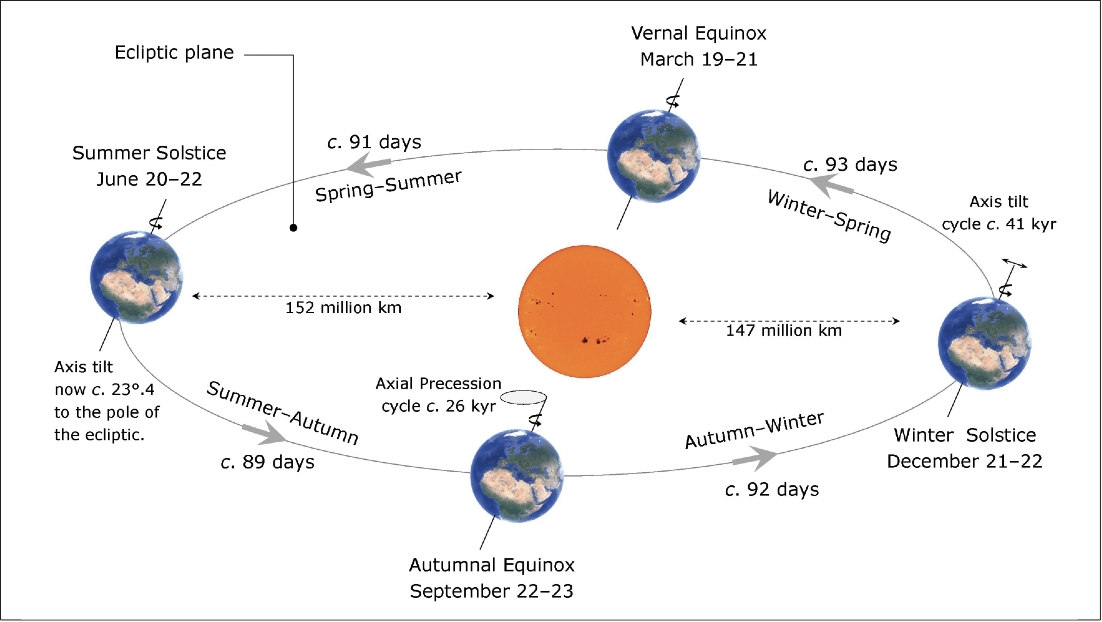
Fig.
1—Earth’s
cycles
and
seasons.